
Pelleting Solution
Overview
A Pelleting Solution is an advanced technology for converting Refuse Derived Fuel (RDF) fluff, agro-residues, or biomass waste into dense, uniform pellets that serve as an alternative clean fuel for cement plants, boilers, gasifiers, and waste-to-energy facilities.
Pelletization not only improves fuel handling and transport efficiency but also enhances calorific value, consistency, and combustion efficiency, making it a sustainable substitute for fossil fuels like coal and petcoke.
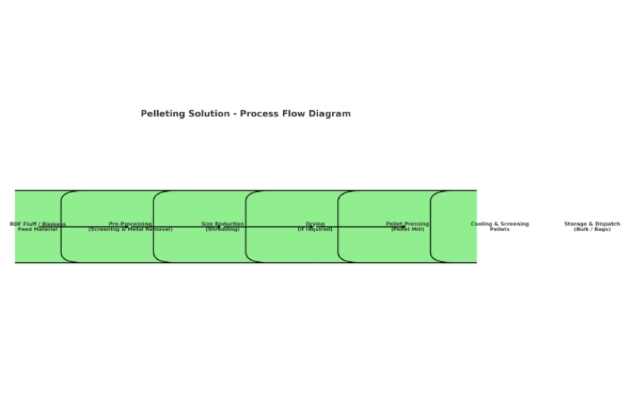
Process Flow
- Pre-Processing
- RDF fluff or biomass residues are screened to remove inerts and oversized impurities.
- Magnetic separation ensures removal of metals.
- Size Reduction (Optional)
- Shredding ensures uniform feed size suitable for pellet presses.
- Drying (if required)
- Waste with high moisture content is dried to the desired level (8–12%) for pelletizing.
- Pellet Pressing
- Material is fed into a pellet mill, where rollers compress it through a die to form cylindrical pellets.
- Cooling & Screening
- Fresh pellets are cooled to harden and screened to remove fines.
- Storage & Packing
- Finished pellets are stored in silos or packed in bags/bulk for transportation.
Key Features
High-Calorific Value Pellets
(3500–5000 kcal/kg depending on input).
Uniform Size & Shape
(6–12 mm diameter).
Compact & Energy Dense
Easier to transport and store than RDF fluff.
Customizable Plant Capacity
From small-scale 5 TPH units to 50+ TPH industrial solutions.
Automation Ready
PLC-based operation for efficient monitoring and control.
Applications
Cement Kilns
Coal/petcoke substitution with RDF pellets.
Industrial Boilers & Furnaces
Consistent clean fuel.
Gasification Plants
Uniform feedstock for energy generation.
Export Market
Pelletized RDF is easier to handle, transport, and sell globally.
Benefits
Converts RDF fluff into valuable, high-quality fuel.
Reduces dependency on fossil fuels like coal & petcoke.
Easier storage, handling, and transportation compared to loose RDF.
Eco-friendly – Promotes circular economy and reduces landfill burden.
Increases market acceptance of RDF by upgrading it into pellets.
Video Gallery

"Driven by quality and innovation, we provide high-performance products that combine strength, efficiency, and durability to meet the evolving needs of modern industries."


Contact US


Corporate Office :- No. 24/ 1, Race Course Road, Behind Narayan Kothi, Indore - 452003, Madhya Pradesh, India
Workshop :- 58A, Sector C, Sanwer Road Industrial Area, Indore-452001, Madhya Pradesh